%20(1).png)

The Budget Dashboard Kit: A Cowork System for Weekly Spending + Debt Payoff
Most budgets fail because they ask you to become someone you're not — the kind of person who categorizes transactions every night, updates a spreadsheet on the 1st and the 15th, or divides cash into labeled envelopes. This isn't that.
The Budget Dashboard Kit is a set of three markdown files designed to work with Claude's Cowork feature. You fill them out once with your real financial picture — income, debts, spending categories, and the values that drive how your household actually makes money decisions. Then you drop them in a folder, download your bank CSV on Sunday, and let Claude do the rest.
What's inside:
A financial values template, where you define how your household thinks about money (non-negotiables, philosophy, what "on track" means for you). A financial structure template, where you fill in the hard numbers (income, accounts, debts, fixed costs, and the math that tells you your real weekly budget). A workflow template, where you pick your spending categories, set targets, and define exactly what your daily check-in and weekly dashboard should look like. Plus a step-by-step setup guide that walks you through the entire process, from installing the app to running your first session.
What you get every week:
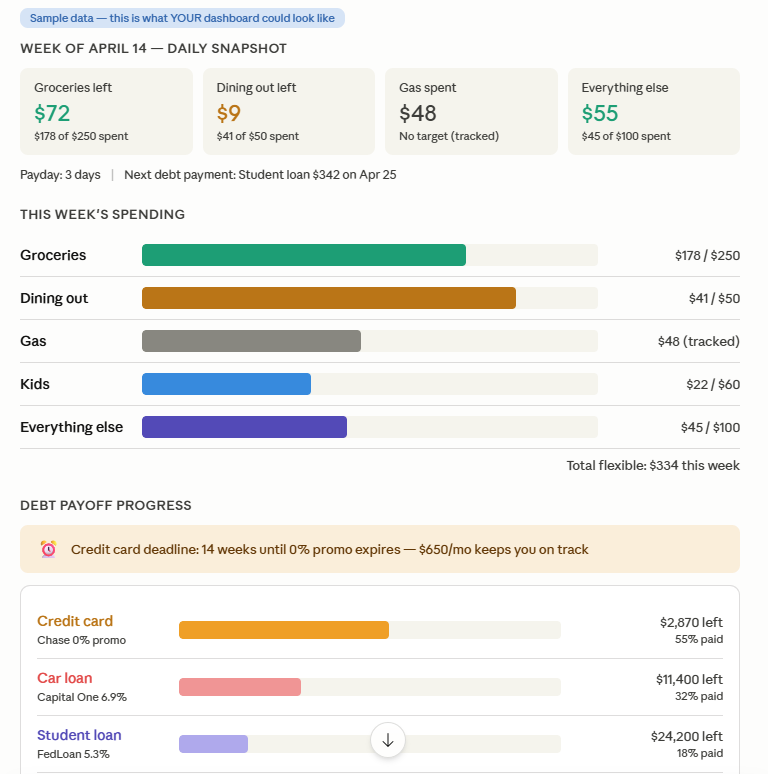
A visual HTML dashboard with color-coded spending bars, debt payoff progress, week-over-week trends, and upcoming bills. A daily text summary you can read in 30 seconds. And a system that asks you about confusing charges before making assumptions — because it knows that a $47 Target trip could be groceries or it could be a Tuesday impulse buy, and only you know which.
What you need to use this:
A Claude account with Cowork access (Pro, Max, Team, or Enterprise plan), the Claude desktop app, and the ability to download a CSV from your bank. No coding, no formulas, no technical background required.
This kit was built by someone who's tried every budgeting app, abandoned every spreadsheet, and finally found something that sticks — by building a system around the person she actually is instead of the person she thought she should be.
